Features testimonials
What is glycation and how does it affect skin collagen?

Read Next Article
Enter your email address for your account and we’ll send a reset link.
New to Absolute Collagen? Join today!
Save 18% when you subscribe to a supplement
From just £19.20
Exclusive Absolute Rewards loyalty scheme
90 day money back guarantee
Edit, skip or cancel anytime
Free delivery & 18% off all recurring orders

You've unlocked Absoluter pricing discounts on our Deep Lift Skincare subscriptions when purchased with a Supplement subscription.
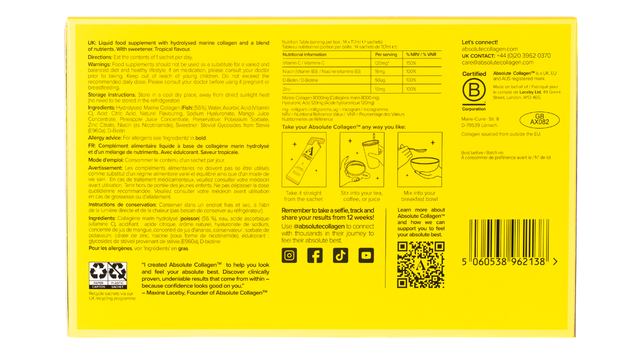
One label might advertise 10,000mg on the front of the pack, while another lists 8g per serving. A third may focus on “Type I collagen peptides” without making the daily quantity immediately obvious.
Fortunately, you don’t need a qualification in nutritional science to make sense of it all. You simply need to know where to look—and which numbers actually belong together.
Here’s how to read a collagen supplement label properly.
Before comparing collagen quantities, find the product’s recommended daily portion.
This might be:
This matters because the quantity shown on the front of a pack may not represent a single capsule, gummy or scoop. It could describe the amount provided by several units.
For example, a bottle might promote “6,000mg of collagen”, but the directions could require six capsules to obtain that amount.
Check three pieces of information together:
UK guidance states that a food-supplement label should identify the recommended daily portion and warn consumers not to exceed it.
Collagen quantities may be displayed in milligrams or grams.
The conversion is simple:
1,000mg = 1g
That means:
A product containing 8,000mg does not provide more collagen than one containing 8g. They are exactly the same quantity written in different units.
Milligrams can create a larger-looking number, so always convert products into the same unit before comparing them.
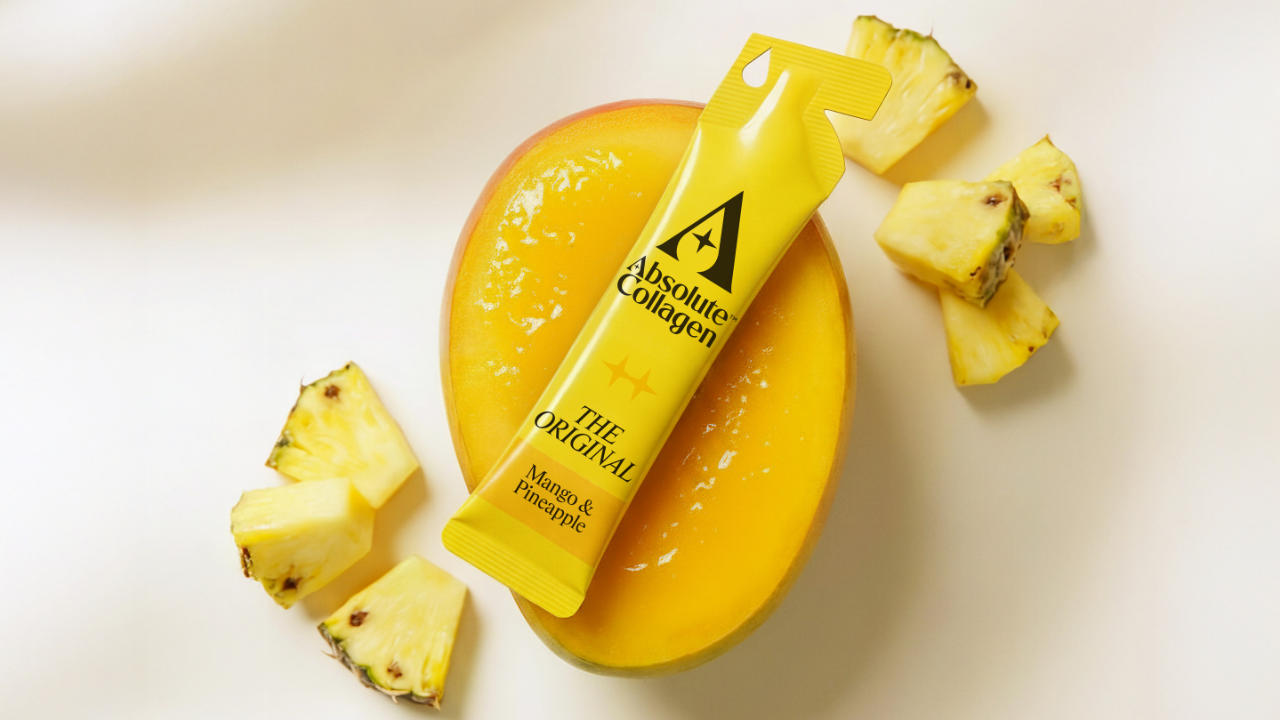
For example, one daily sachet of our Marine Collagen Liquid Drink provides 8,000mg—or 8g—of hydrolysed marine collagen.
Some labels highlight the total collagen contained in the entire tub or pouch. That number may look impressive, but it doesn’t tell you how much you will consume each day.
Imagine two powder products:
Product B contains more collagen in total, but Product A provides the larger daily serving.
Neither figure automatically makes one product better. They answer different questions:
When evaluating the price, work out the cost per recommended daily serving rather than comparing pack prices alone.
Not necessarily.
Published studies have investigated a range of collagen-peptide doses, often varying according to the formulation, intended outcome, duration and study design.
More is not automatically more effective, and the largest number on the pack isn’t proof of better results.
A useful label should make the dose clear. The evidence used to support a product should also relate as closely as possible to:
Be cautious when a brand refers vaguely to “scientific studies” without explaining whether the research examined its own formulation, the same ingredient or merely collagen in general.
Collagen supplements are animal-derived. Common sources include:
The source matters for several reasons.
Fish is one of the 14 allergens that must be declared under UK food-information rules. If a product contains marine collagen, check the ingredients and allergen statement carefully.
Allergens should be emphasised within the ingredients list, often using bold text.
Do not use marine collagen if you have been advised to avoid fish. Speak to an appropriate healthcare professional if you are uncertain about an allergy.
Collagen is not suitable for vegans because it comes from animals. Most collagen supplements are also unsuitable for vegetarians.
If halal or kosher certification matters to you, look for certification from a recognised body rather than relying on assumptions based on the collagen source alone.
Responsible brands should be able to explain where their collagen comes from and how it is processed.
Useful information might include:
Words such as “premium”, “pure” and “clean” sound appealing, but they are most useful when the company clearly explains what they mean.
A label may use terms including:
These terms generally describe collagen that has been broken into smaller peptide chains through a process called hydrolysis.
A peptide is a short chain of amino acids. Hydrolysing collagen makes it easier to dissolve and suitable for use in drinks, powders and other supplement formats.
Hydrolysed collagen is not the same as the intact collagen fibres found in your skin. During digestion, collagen peptides are broken down and absorbed as amino acids and small peptides.
The word “hydrolysed” does not, by itself, prove that a product will deliver a particular result. The quantity, formulation, supporting research and consistency of use still matter.
Some collagen labels or product pages advertise a particular molecular weight, usually measured in daltons.
This can provide information about the approximate size of the peptides, but a lower molecular weight should not automatically be interpreted as a better product.
Peptide distribution can vary, and one technical number cannot tell you everything about:
If a brand makes a benefit claim based on a particular patented peptide ingredient, look for research involving that ingredient and an equivalent daily dose.
Scientists have identified numerous types of collagen in the human body. Type I is abundant in skin, bones, tendons and other connective tissues, while Type II is strongly associated with cartilage.
Marine and bovine collagen supplements are often promoted according to the collagen types present in their source material.
However, swallowing “Type I collagen” does not mean intact Type I collagen travels directly to your face. Collagen is digested into amino acids and peptides before those components are distributed through the body.
The collagen type can help describe the source material. It should not be treated like a delivery address.
Look at the complete evidence for the product rather than assuming a Roman numeral guarantees a particular outcome.
Collagen is a protein, but the labelled quantity of collagen and the nutrition-table value for protein may not be identical.
For example, a product might declare:
This difference can reflect how protein is calculated and the composition of the complete product.
Also remember that collagen is not a complete protein. It does not supply all nine essential amino acids, so it should not replace varied dietary protein sources.
If your goal is muscle maintenance or meeting a clinically recommended protein target, compare the product with appropriate complete protein sources rather than assuming every gram of protein is nutritionally interchangeable.
For a deeper explanation, read our guide to whether collagen is a complete protein.
The front of the pack is designed to catch your attention. The ingredients list tells you what is actually inside.
Ingredients are generally listed in descending order by weight. Depending on the format, a collagen supplement might also contain:
Additional ingredients are not automatically a problem. A ready-to-drink liquid will naturally require a different formulation from an unflavoured powder.
What matters is whether the ingredients suit your dietary needs, preferences and any allergies or intolerances.
Vitamin C is often added to collagen supplements because it contributes to normal collagen formation for the normal function of skin, bones and cartilage.
On the label, check:
The Nutrient Reference Value, or NRV, is a benchmark used on food labels. It is not a personalised prescription and does not mean you need to obtain exactly 100% from a supplement.
More is not always better. If you take a multivitamin, fortified drink and collagen supplement, review the combined intake rather than examining each product in isolation.
Collagen products may include nutrients such as:
Added nutrients can make a product more complex, but a longer ingredient list does not automatically mean a superior supplement.
Ask four questions:
Pay particular attention when stacking several supplements. Nutrients from each product contribute to your total intake.
If you are pregnant, breastfeeding, taking medication or managing a medical condition, seek appropriate professional advice before starting a multi-ingredient supplement.
Collagen labels can contain several abbreviations.
Nutrient Reference Value is used for vitamins and minerals. A label may state that a serving provides a certain percentage of the NRV.
Reference Intake is commonly used for energy and nutrients including fat, saturates, sugars, protein and salt.
mg means milligrams.
µg means micrograms.
One milligram equals 1,000 micrograms, so take care when comparing the two units.
These are measures of energy. Kilocalories are commonly referred to as calories, while kilojoules provide the metric energy value.
Food supplements are not medicines and should not claim to diagnose, treat, cure or prevent disease.
There is also a difference between:
For example, an authorised vitamin C claim can state that vitamin C contributes to normal collagen formation for the normal function of skin. That is not the same as claiming that every collagen product reverses wrinkles or treats a skin condition.
When a label makes a benefit claim, look at the evidence attached to it.
A credible evidence statement should make clear:
Testimonials can describe individual experiences, but they do not guarantee that everyone will see the same result.
This is a standard we’ve applied to our own research.
Our independent, double-blind, placebo-controlled and peer-reviewed clinical trial tested the same daily formulation our customers take: 8,000mg of hydrolysed marine collagen with vitamin C.
The study followed 130 adults aged 40–60 over 12 weeks. Measurements were taken at the beginning and again after six and 12 weeks.
That distinction matters. When comparing collagen supplements, check whether the research examined the finished product at its recommended daily dose—or a different ingredient, quantity or formulation.
A study into a completely different collagen product cannot automatically prove that the product in your hand will deliver the same results.
You can explore our study design, measurements and findings on our collagen clinical trial results page.
A supplement label cannot tell you everything about manufacturing quality, but it can point you towards useful checks.
Look for:
“Third-party tested” is useful only if the brand explains what was tested, by whom and against which standards.
Testing might cover identity, microbiological safety, heavy metals, contaminants or the stated ingredient quantity. One test does not necessarily cover every quality question.
A low pack price can be misleading if the product supplies fewer servings or requires several units each day.
Use this calculation:
Pack price ÷ number of recommended daily servings = cost per day
Then compare that cost with:
A powder pouch might offer a lower cost per gram, while individually measured powder sachets may provide greater convenience.
The best-value option is the one that combines an appropriate formulation with a routine you can realistically maintain.
Before buying, see whether you can answer each of these questions:
If important information is missing, ask the brand before you buy.
A useful collagen label should make the fundamentals easy to find:
Don’t be distracted by the largest number or longest ingredients list. Compare like with like, read beyond the front of the pack and decide whether the product fits your needs.
Explore our collagen supplements or take the Absolute Collagen quiz to find the format that best suits your routine.
Eight thousand milligrams is equal to 8g.
The terms are commonly used to describe collagen that has been broken into smaller peptide chains through hydrolysis.
Marine collagen is derived from fish. Do not take it if you have been advised to avoid fish, and seek professional guidance if you are uncertain about an allergy.
No. A higher number does not automatically mean better results. Consider the formulation, supporting evidence, study duration, recommended serving and suitability for your needs.
NRV means Nutrient Reference Value. It is the daily reference amount used when declaring vitamins and minerals on food labels.
No. Collagen is derived from animal sources such as fish, cattle, pigs or chicken.
Collagen is an incomplete protein and does not contain all nine essential amino acids. It should not replace complete dietary protein sources or a product recommended specifically for meeting a complete-protein target.
Testing the finished product helps show that the research relates to the formulation and daily dose being sold. Research into a different ingredient or dose may be less directly relevant.